


Would there even be a Bill of Rights without the influence of Baptists?


James Madison is often called the Father of the Constitution. He helped shape the structure of the new American government and later introduced the amendments that became the Bill of Rights.
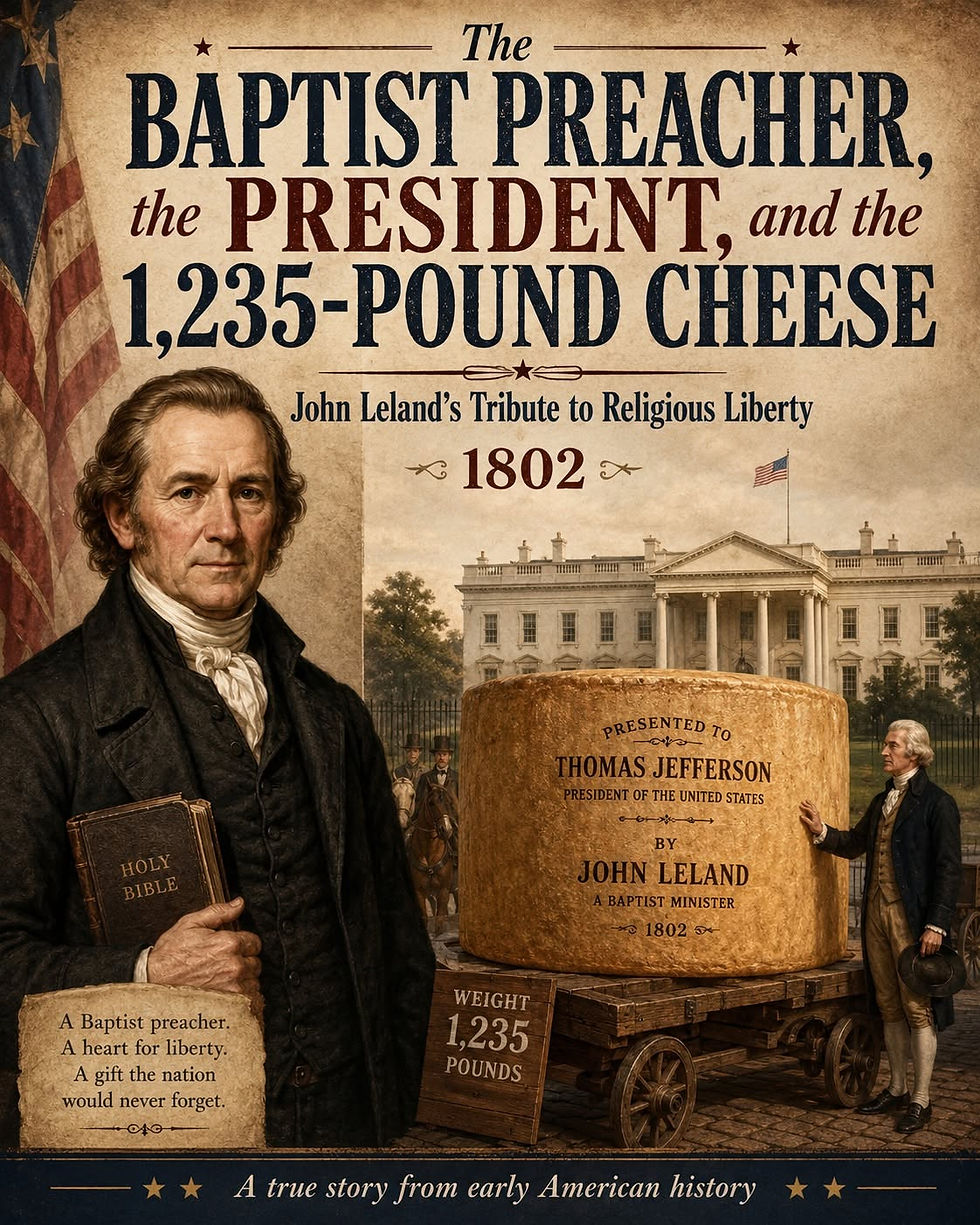
John Leland was a Baptist preacher, evangelist, and passionate defender of religious liberty. He believed that no government had the right to command the conscience, compel religious belief, or force one man to pay for the religion of another.
For Leland, religious liberty was not merely a political preference. It was a biblical conviction. The church does not need the sword of government to preach the gospel, and the government must never be allowed to become lord over the soul.
That conviction mattered deeply in early America because Baptists knew better than the other religious groups what it meant to be religious outsiders. Before the Revolution, in colonial Virgina the church of England held a privileged place and those preachers who were not of that church were required to get governmental permission in order to preach. Baptist preachers refused to accept the notion that the government had authority over who could or could not preach.
To them, Christ, not the colony’s government, called men to preach.
In the 1760s and 1770s, Baptist ministers in Virginia were arrested, fined, harassed, and sometimes jailed for preaching without a license or for holding unauthorized religious meetings. Men such as Lewis Craig, John Waller, James Childs, and others found themselves treated as disturbers of the peace instead of ministers of the gospel.
In Spotsylvania County in June 1768. Baptist preachers were seized during a worship service, brought before magistrates, and ordered to appear in court. Their offense was not theft, violence, or rebellion. Their offense was preaching Christ without the permission of the established religious authorities.
Yet prison did not silence them.

Some of these incarcerated Baptist preachers preached through jail windows while crowds gathered outside to listen. Their imprisonment became a living sermon. The government could lock the preacher in a cell, but it could not lock up the Word of God.
Even in America, Baptists learned by bitter experience that religious liberty was not a luxury; it was a necessity. A government powerful enough to favor one church was powerful enough to punish another.
That is why Virginia Baptists particularly became some of the strongest voices for liberty of conscience in early America. They did not merely want freedom for Baptists. They wanted freedom for every soul to stand before God without coercion from the state.
Their suffering helped prepare the way for the First Amendment.
So, when the new United States Constitution was proposed without a clear Bill of Rights, many Baptists were concerned.
James Madison believed the Constitution was strong as written. John Leland and many Baptists disagreed ... and Madison needed the support of the Baptist to pass it into law.
According to longstanding accounts, during the debate over whether to ratify the constitution, Leland and Madison met near an oak tree in Orange County, Virginia. The details of that meeting have been retold in different ways, and not every part of the story can be proven with certainty. But the historical point is clear enough: Madison needed Baptist support, and initially Leland opposed ratification because it did not include a bill of rights.
According to the account of this meeting, Madison pledged to support amendments protecting religious liberty and in exchange Leland would throw his support behind Madison. Madison kept his word and went on to play a leading role in drafting the first Amendment which includes these words: “Congress shall make no law respecting an establishment of religion, or prohibiting the free exercise thereof.”
Here is the important thing: John Leland did not want a Baptist nation. He wanted a free nation. He did not ask the government to make Baptists powerful. He asked the government to leave the conscience free. That is worth remembering.
Their argument was simple: If Christ is Lord, Caesar is not.
The state may govern conduct, but it must not govern conscience.
It may punish crime, but it must not compel worship. It may protect citizens, but it must not pretend to save souls.
The truth does not need chains. The church does not become stronger when it borrows the power of the state. It becomes stronger when it trusts the power of God’s Word and the Spirit.
So yes, James Madison deserves his place in American history, but somewhere near him, perhaps in the shadow of an old Virginia oak, stands a Baptist preacher named John Leland.
And every time we speak of religious liberty, every time we thank God that the government cannot dictate our worship, and every time we remember that conscience belongs to God alone, we are remembering how God used Baptists to shape American freedom.
That is a heritage we want to always remember and not only that ... it is a liberty worth defending.


Comments